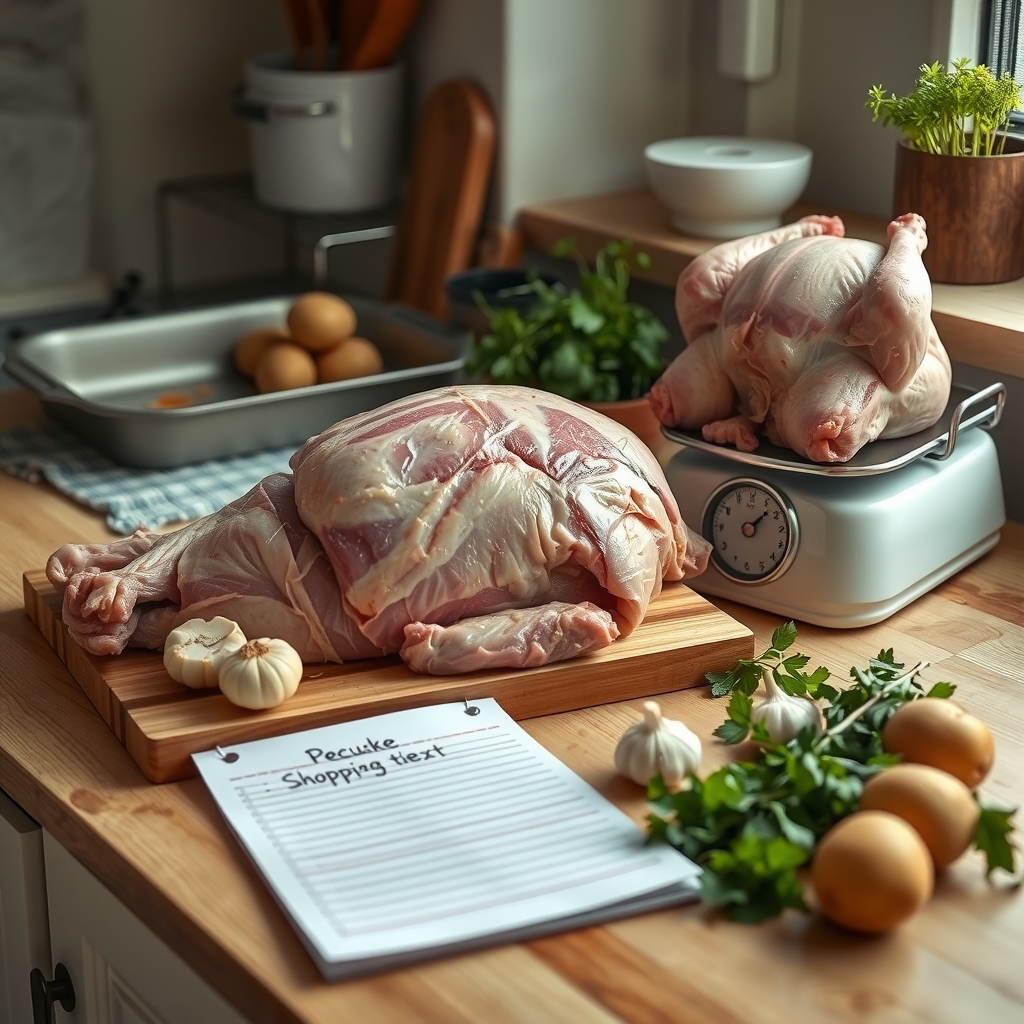
For a lunch where meat is the main course, allow about 200 g of raw boneless meat or 300 to 400 g of bone-in meat per adult. If soup, two sides and a salad are also on the table, 150 to 200 g of boneless meat is enough, and children need roughly half an adult portion. Below you will find a quick table for 4 to 10 people, portion sizes for sides and a few tips so you are not left with half a roasting tin.
The basic rule: how much meat per person
Kitchen portion charts broadly agree. A Slovenian “kitchen maths” guide published by Svet24 gives 150 to 200 g of raw roast per person, 120 to 150 g of mince or boneless meat and 200 to 250 g of bone-in poultry. British butchers recommend 200 to 250 g per person for boneless joints and 300 to 450 g for bone-in joints, because bone and trimmings account for much of the weight.
These ranges do not contradict each other: the lower figure suits a multi-course lunch with soup and several sides, the higher one a meal where the meat is the star. For an everyday family lunch you will be near the lower end; for a celebration lunch, such as a birthday or christening, plan towards the upper end.
- Boneless meat (pork loin, beef fillet, turkey breast): 150–250 g per adult.
- Bone-in meat (pork ribs, rack, leg of lamb): 300–400 g.
- Chicken: 150–200 g of fillet or 250–350 g of bone-in pieces; a whole chicken of about 1.4 kg feeds four.
- Steaks, schnitzels, mince, meatballs: 120–180 g.
- Children: roughly half an adult portion; teenagers as adults.
Table: how much meat for 4, 6, 8 or 10 people
The figures below are based on the middle of the range, around 200 g of boneless or 350 g of bone-in meat per adult. If you are expecting hungry guests or want leftovers for Monday, add 20 to 30 per cent.
| Adults | Boneless meat | Bone-in meat | Potatoes (side) |
|---|---|---|---|
| 4 | 0.8 kg | 1.4 kg | 0.8 kg |
| 6 | 1.2 kg | 2.1 kg | 1.2 kg |
| 8 | 1.6 kg | 2.8 kg | 1.6 kg |
| 10 | 2.0 kg | 3.5 kg | 2.0 kg |
If you are serving two kinds of meat, say a pork roast and chicken, do not double the total. Split it instead: guests will take a little of each and usually eat only slightly more than they would with a single meat.
Why meat shrinks in the oven
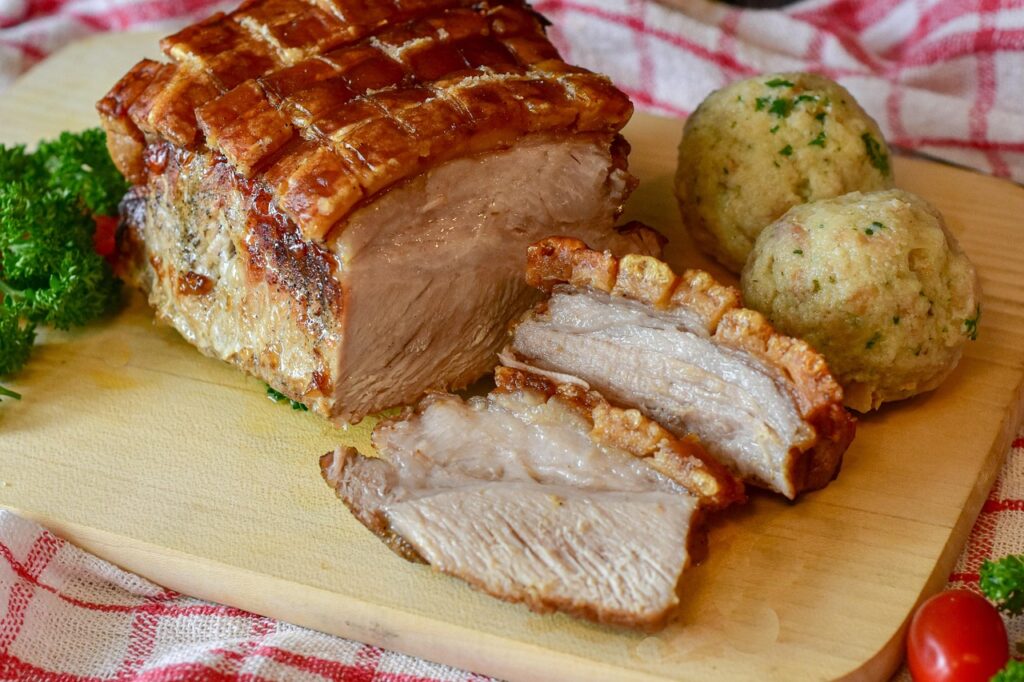
Meat loses water and fat as it cooks. Lean roasts shrink by about 20 to 25 per cent, while fattier cuts that are braised or slow-roasted for hours (neck, shoulder, brisket) lose 30 to 35 per cent or more. So 1 kg of raw pork shoulder gives you roughly 650 to 700 g of meat on the plate.
That is why every quantity in this article refers to the raw weight, as shown on the butcher’s scales. You can limit shrinkage a little: avoid overcooking, use a meat thermometer and let the roast rest for 10 to 15 minutes before carving so the juices stay in.
Meat for soup
In Slovenia, many Sunday lunches start with beef soup; the boiled beef is then served with horseradish and potatoes. If you plan to serve it as the main course, count it as bone-in meat. As a starter, 200 to 250 ml of soup per person is enough.
Sides and salad: how much per person
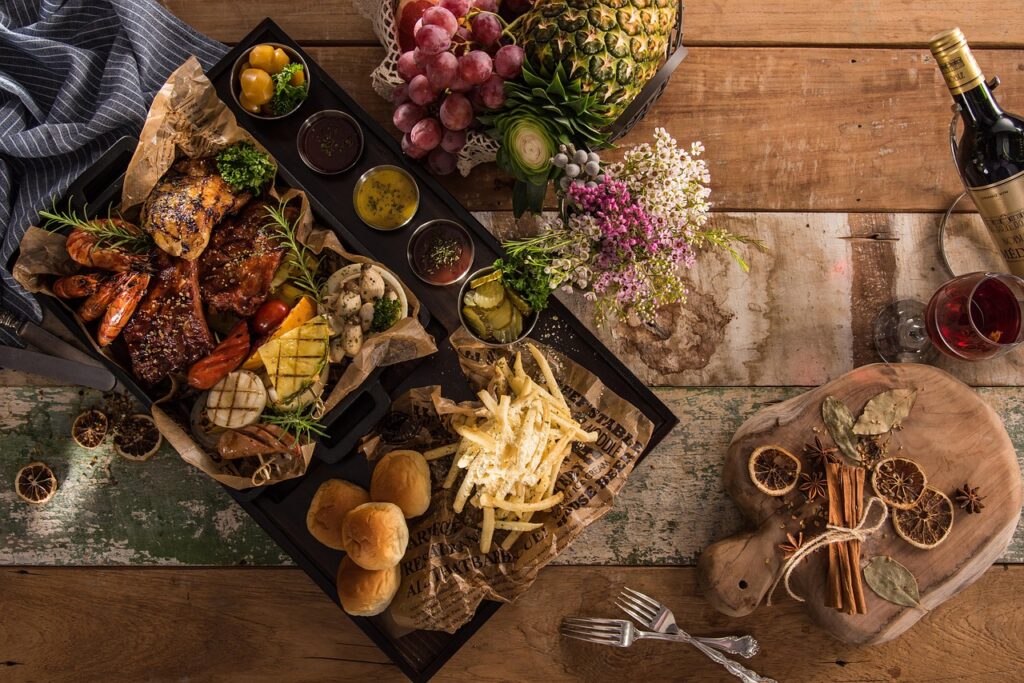
The more generous the sides, the less meat you need. With two or three sides you can reduce the meat by 10 to 15 per cent. Approximate raw quantities per adult:
- Potatoes (roasted, in wedges): 150–200 g; sautéed or for salad 200–250 g.
- Rice or grains (dry weight): 50–80 g as a side.
- Dried pasta: 50–80 g as a side, 100–125 g as a main.
- Vegetables as a side: about 150 g.
- Green salad: 50–80 g; other salads (tomato, cabbage, beans) 100–180 g.
- Bread: 75–125 g.
Adjusting for the occasion
For a Saturday family lunch, where everyone knows each other’s appetite, you can buy precisely. For a birthday celebration lunch with relatives of all ages, a little extra is worth it, as leftovers are less of a worry than an empty dish. A few tried-and-tested adjustments:
- Big meat eaters: add 15–20%.
- Older guests and children: plan for less; the lower end is often enough.
- Buffet: choose boneless meat, which is easier to carve and portion.
- Planned leftovers: add 20–30% and use the roast next day for sandwiches, goulash or risotto.
It is also worth thinking about health. Slovenia’s national dietary recommendations advise eating red meat no more than two to three times a week, and the Slovenian public health institute NIJZ warns that more than 300 g of red meat and meat products a week may already carry a risk (summarised by N1, in Slovenian). After a festive lunch, make the rest of the week more vegetable-based, and for everyday lunches feel free to shrink the meat portion.
Storing leftovers
Cool roasted meat within two hours, cover it and keep it in the fridge, where it lasts two to three days. For longer storage, slice it, pack it in bags and freeze it so you can later thaw only as much as you need.
Frequently asked questions
How much meat per person should I buy for lunch?
Allow about 200 g of raw boneless meat or 300 to 400 g of bone-in meat per adult when meat is the main course alongside soup, a side and salad. With plenty of sides, 150 to 200 g of boneless meat is enough.
How much meat do I need for 10 people?
For 10 adults buy roughly 2 kg of boneless meat or 3 to 3.5 kg of bone-in meat. If you want leftovers for the next day, add another 20 to 30 per cent.
How much meat per child?
For younger children allow about half an adult portion, so around 100 g of boneless meat. Teenagers often eat as much as adults.
How much chicken per person?
Allow 150 to 200 g of boneless chicken breast or fillet per person, or about 250 to 350 g of bone-in pieces. A whole chicken of about 1.4 kg feeds four adults.
How much does meat shrink when roasted?
Lean roasts lose about 20 to 25 per cent of their weight, while fattier cuts that are braised or slow-roasted lose around 30 to 35 per cent or more. That is why the raw weight is always higher than what ends up on the plate.